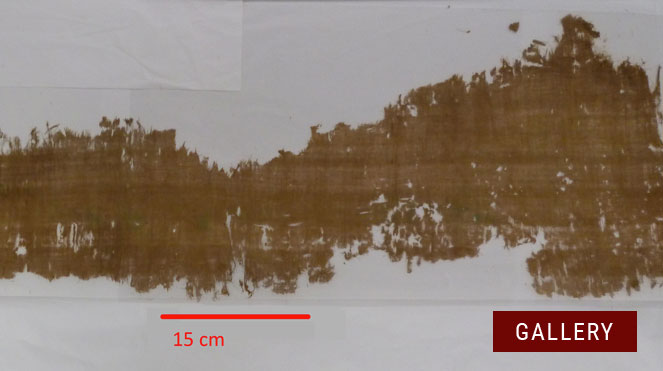
The fragments belonging to HNAM inv. no Π 9653 do not represent a woven textile. Instead, they appear to form part of a mat-like construction composed of very thick, ribbon-like elements with no observable ligature or interlacing. Their morphology suggests that the grave or the deceased may have been covered with layers of bark rather than with a textile. Because of the nature and state of preservation of the material, no thread diameters or technical measurements could be taken.
The third textile quality is a small fragment of weft-faced tabby with spliced S2*z threads of ca. 0.45 mm in diameter in both directions. The fragment preserves part of a side edge of the fabric. The edge shows a particular reinforcement technique where the weft passes over and under the two last warp threads when it arrives at the edge. A similar side edge has been observed in a 5th c.
The study indicates that this is a, most probably, wool fabric (today very much degraded), dyed in a bright purple colour (at least near the decoration) and decorated with tapestry patterns made using a supplemental, thicker linen thread in the natural shade of flax.
The find is composed of a large mineralised tabby, on the surface of which there are traces of a second fabric. These traces, scattered all over its surface, on both sides, seem to belong to a very degraded, dark coloured fabric, once decorated with tapestry patterns and dyed purple.
The bronze blade conserves part of the textile with which it was wrapped. One side preserves a large fragment conserved in multiple layers (in some areas more than six) in a mineralised condition. The other side preserves minute traces on the blade, as well as a textile fragment on the nails, indicating that this side was also in connection to the fabric. The second side preserves also a silver wire of unknown use.
Still adhering to the bronze dagger it used to cover, this is a well-preserved balanced tabby, only superficially mineralised. It is conserved on one side of the dagger and covers almost all its surface, from the nails to the tip. It is damaged and torn in many places, folded in others and lays on the dagger without indication about whether it was originally wrapped around it.
The fabric is a balanced tabby with a thread count of 19 threads/cm for the warp and 21-22 threads/cm for the weft. The threads have the characteristics of spliced threads with an S-twist for the final thread and a z-twist for each single thread (Gleba and Harris 2018).
Among the textiles found with the fragmented bronze vase, several display the characteristics of tapestry decoration. They mostly conserve a single thread direction, the weft forming the decoration, while minute traces of very degraded, blackish, warp threads are visible between the weft.
Some freestanding fragments found among the fragments of the vase HNAM inv. no Π 9566 present a weft-faced tabby. The fragments are preserved without any conservation treatment, which, in normal circumstances, allows for a more detailed macroscopic study.